
 Medically reviewed by Dr. Omar Alexis Guadarrama Tarazón · Medical License (Cédula Profesional) 14685220
Updated:
What is an FUE hair transplant?
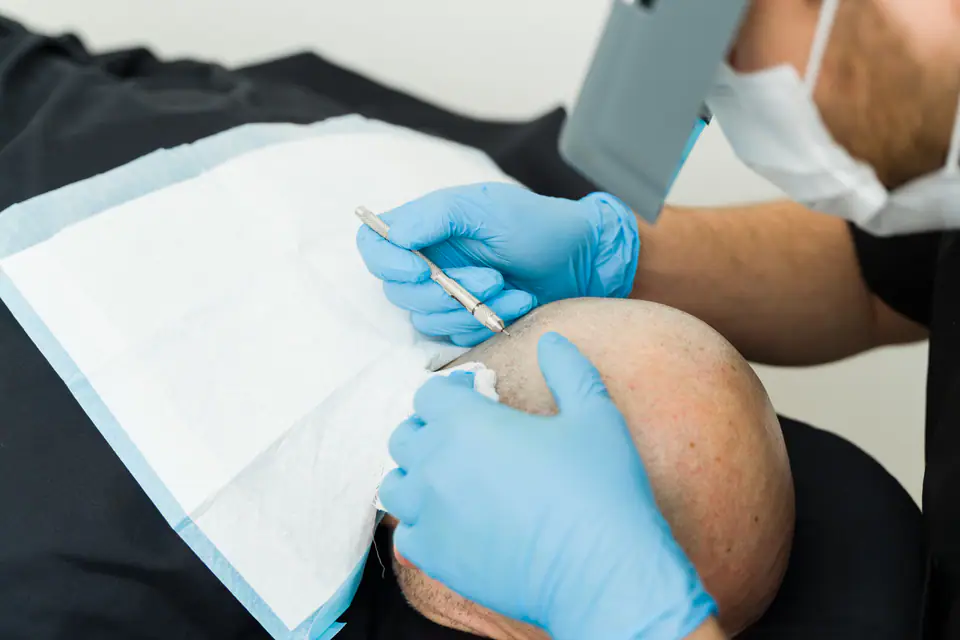
FUE stands for Follicular Unit Excision. It’s the technique used to harvest, one by one, the follicles that are later implanted into thinning or balding areas during a hair transplant.
A follicular unit is the way hair naturally grows: small groups of one to four hairs coming out of the same point. Extracting them individually allows them to be transplanted just as they grow — a key to a natural-looking result.
Where is the hair taken from?
Hair is taken from the donor area: the back of the head and, when needed, the sides.
“People with baldness keep the hair on the back and sides of their head, like a Tibetan monk: those areas resist hair loss. That’s where we extract the hair, one follicle at a time.”— Dr. Alexis Guadarrama
If a family member of yours is bald, you’ve probably noticed it: even when they lose the hair on top, they keep it on the back and sides. That’s why these areas are the ideal source for a transplant — hair taken from there keeps its resistance once transplanted.
How is FUE performed?
Using a precision instrument, each follicular unit is extracted individually, hair by hair. Extractions are spread across the donor area so it keeps a uniform look once the hair grows back.
The extracted follicles are carefully preserved until they’re implanted with the DHI technique.
Benefits of FUE
- No linear scar: unlike the strip technique (FUT), no band of skin is removed.
- Follicle-by-follicle selection: the most suitable follicular units are chosen for each area.
- Outpatient procedure: you go home the same day.
- Natural result: hair is transplanted the way it grows, in follicular units.
FUE and DHI: two techniques that work together
FUE and DHI don’t compete: one is the technique to extract, the other to implant. At Regenere they’re combined — FUE harvests the follicles, and DHI places them directly into the balding areas with implanter pens, following your hairline design.
Who is a candidate for FUE?
People with pattern hair loss and a donor area with good density. During your consultation, the doctor assesses your donor area to plan how much hair can be harvested without affecting its appearance.